When I first travelled in China in the mid 1990s it was obvious that the United States of America’s hegemony on the global stage was fading fast and that the People’s Republic of China was growing… increasingly rapidly and differently. By the mid 2020s, there now exists a dual hegemony. China is an ancient civilization that evolved into a modern country, while the USA is a modern country that developed its own new civilization.
There is so much diversity reflected in China’s geography, history, culture, politics and people. It is fascinating and important to understand it. It is not easy to understand, however, especially for a person who is used to Western civilization culture and system. All the more reason to spend time in China!!
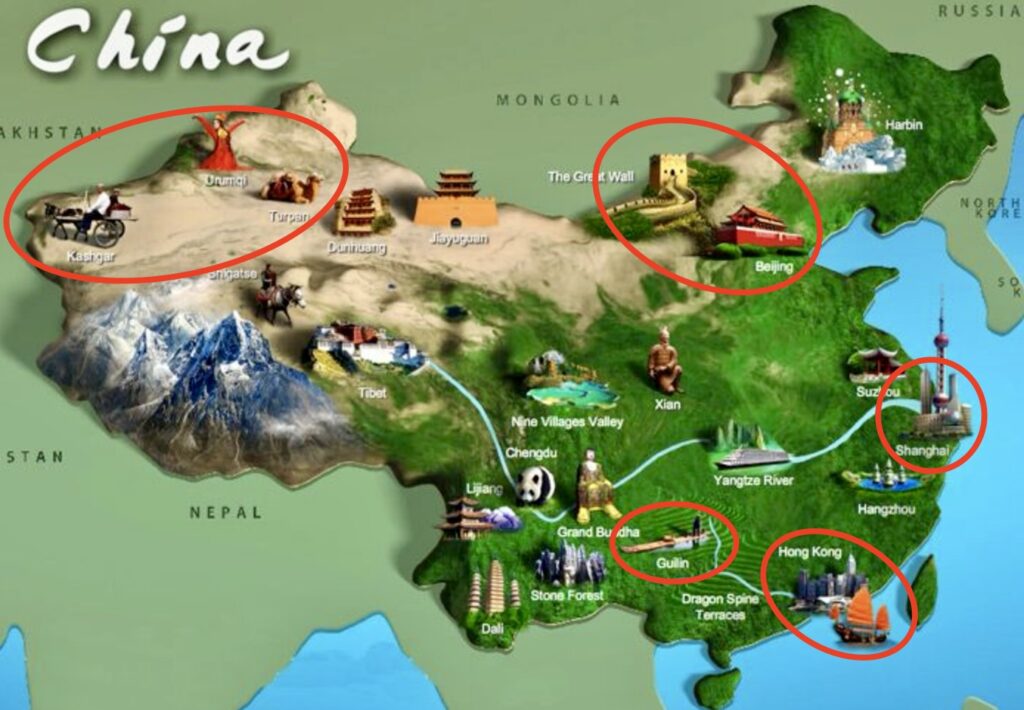
I’ve spent more time in China than most countries I’ve visited or lived in, with a year living in Hong Kong, five subsequent trips to Hong Kong, three separate trips to each of Beijing, Shanghai and Macau, a separate trip to each of Guilin and Guangzhou and a month travelling overland through Xinjiang (from Kazakhstan to Urumqi, exploring Turpan, down to Kashgar and over the Kunjurab Pass into Pakistan). Most of my time in China has been fantastic although there have also been moments of mishap, racism towards me and corruption. Some of those stories are within the various locations linked on the China page.
My first phase of my time in China was marvelling at everything on various holidays from Hong Kong, in 1996/97. Reflecting as I write, if I had my time again when I was living in Hong Kong I would have diverted more of my time to a trip to Tibet exploring Lhasa, Shigatse and the Himalayas. The second phase in China was through immersion as an overland backpacker in Xinjiang, in late 1997. The third phase was as a result of work in financial services where I was travelling to Beijing and Shanghai as the Chinese financial services market was beginning to open up to be more of an integrated part of the global system, in 2000s. The fourth phase was visiting family and friends who lived in Hong Kong through the later 2000s/10s.
Despite all of this time, immersion, experiences and observations, I still need to be mindful of Chinese culture, philosophical and religious beliefs, and objectives when understanding their actions and messages as they play out day to day, especially as one of the world’s leaders.
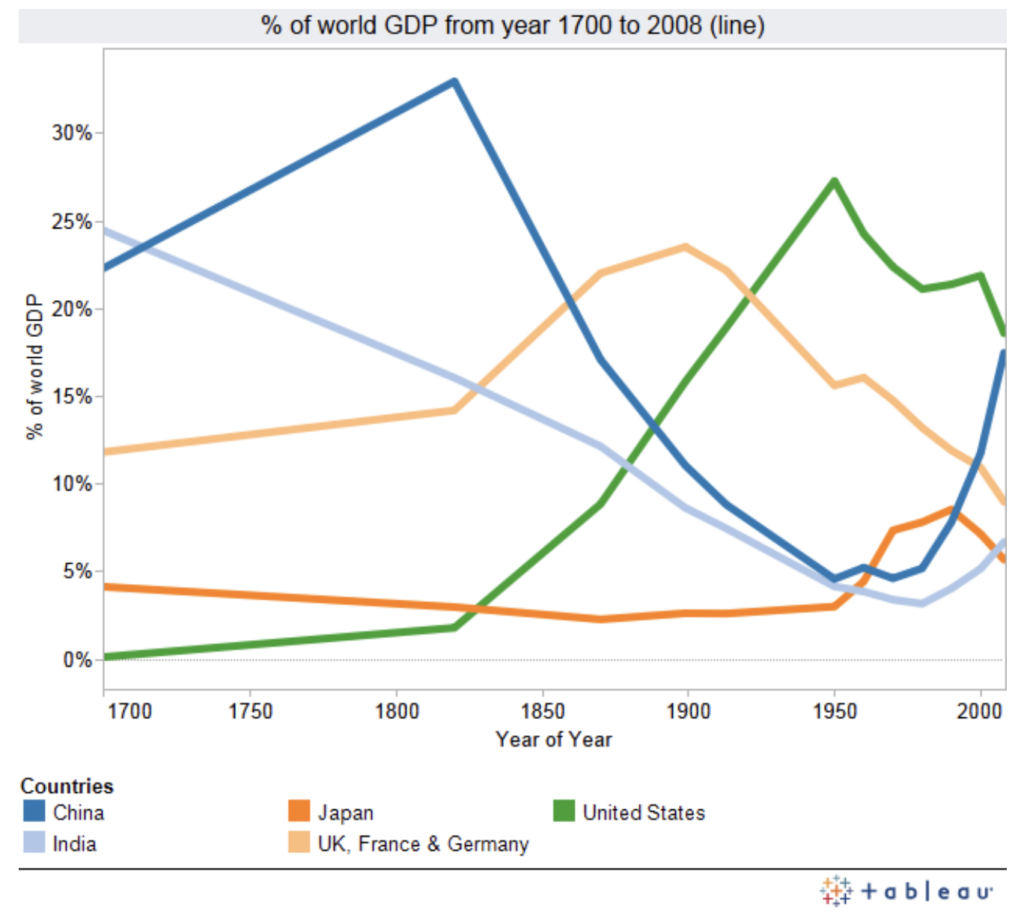
In 1996, when I first visited, China’s economy was no more than 6% of world GDP, whilst in just 30 years, today it has grown to nearly 20%. China has grown from being a massive country in landmass and population with a fascinating culture, heritage and natural beauty to also be a dominant country in terms of its economic, political, military influence. In 1996, most of what happened in China or its involvement in global politics went unseen outside of China. Today, with China’s influence, power and position, plus with the evolution of media, the result is that it is much more in the world’s eye.
Chinese decision-making is primarily driven by three overarching priorities: regime survival and absolute Party control, the pursuit of national rejuvenation to reclaim great-power status, and national security through technological and economic self-reliance.
Breaking these down further, on a political level, the paramount driver is regime security, i.e. the absolute authority of the Chinese Communist Party (CCP). Every decision aims to eliminate threats to Party rule, leading to strict ideological enforcement and sweeping anti-corruption purges to maintain internal discipline. This ideological necessity for the CCP has been the primary driver behind historical events with a hardline approach including the repression of Uyghurs in Xinjiang (2017), the squashing of mass pro-democracy demonstrations in Hong Kong (2019), the Tiananmen Square Massacre (1989), and the Cultural Revolution (1966 – 76). In the past decade, decision-making has shifted from collective, consensus-based leadership to highly centralized control, with supreme authority consolidated under the paramount leader, Xi Jinping. Another core political driving force is the memory of the “Century of Humiliation” fuelling deep-seated nationalism and a long-term goal of restoring China to a central, dominant position in global affairs.
The Century of Humiliation refers to a period of intervention, military defeats, and territorial concessions suffered by China at the hands of Western powers and Japan from roughly 1839 to 1949. This era began with the First Opium War and ended with the establishment of the People’s Republic of China. China today aims to restore its position to what it was before The First Opium War, which includes the controversial pursuit of Taiwan.
Economically, the CCP’s right to rule rests heavily on its ability to deliver economic growth, public goods, and rising living standards. Keep the people happy! This requires balancing market-oriented growth with the state’s retention of control. Driven by fears of foreign embargoes and supply chain disruptions, economic policy heavily prioritizes self-sufficiency in critical sectors like artificial intelligence, green energy, and semiconductors. Long-term economic blueprints are directed by state “Five-Year Plans“. Recent decision-making also focuses on mitigating systemic financial risks, such as local government debt and property sector bubbles.
Thirdly is military capability. The People’s Liberation Army (PLA) is fundamentally the armed wing of the CCP and its core mandate is to protect the Party and its interests, rather than act as a neutral defender of the state. “Military-Civil Fusion” is a strategic driver to eliminate barriers between the civilian and government defence sectors. It legally synchronizes all state resources, including private research and overseas collaboration, to modernize the military. Military planning is driven by the goal of projecting power in the Indo-Pacific Oceans, securing territorial claims, such as Taiwan and the South China Sea, and ultimately creating a world-class military by 2049.
I have found that understanding Chinas’ approach as a leader in the world or whilst travelling as an individual within the country is reasonably relatable in the above perspectives of politics, economics and military. The more complicated aspect is when you overlay the traditional Confucian philosophy, and Taoist and Buddhist beliefs and how they deeply shape Chinese peoples’ behaviour and actions.
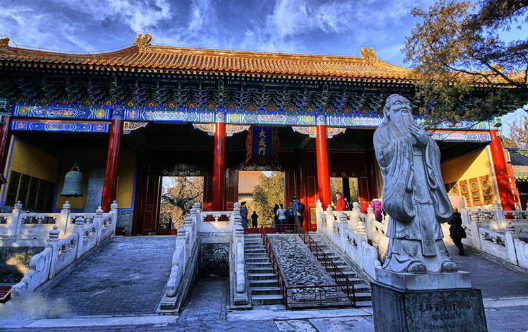
As a side note, the main image for this post is of the Beijing Temple of Confucius, the second-largest Confucian temple in China, originally built in 1302.
Confucianism and traditional Chinese beliefs deeply shape their approach in international politics by always seeking to prioritize social stability, hierarchy, and moral legitimacy. This philosophy drives China to view international relations through the lens of long-term planning, mutual obligations, and the projection of moral superiority over raw physical force. The profound influence of these traditions on Chinese behaviour and political decision-making spans several distinct areas:
1. The primacy of harmony and stability
* Domestic vs. International: Confucianism emphasizes the interconnectedness of society and the need for clearly defined, respectful roles to maintain stability. In world politics, this translates into an intense focus on sovereignty, national unity, and resistance to external interference. Beijing views internal stability as a prerequisite for acting effectively on the global stage.
* Global governance: China frequently promotes concepts like a “Community of Shared Future for Mankind”. This reflects the traditional Chinese belief in achieving global equilibrium (or Datong) and managing relations through mutual dependence and respectful hierarchy rather than imposing unyielding values on other nations.
2. Moral authority and statecraft
* The “Kingly Way” (Wangdao): In traditional Confucianism, a true leader (Junzi) rules through benevolence and moral virtue rather than physical dominance.
* Geopolitics: China often portrays its foreign policy in this light, contrasting its approach of economic development and diplomacy with the hegemonic use of force or coercion. This manifests in initiatives emphasizing mutual economic gain, e.g. the Belt and Road Initiative, as a form of benevolent statecraft.
3. Hierarchical relationships and “face”
* Diplomatic strategy: Chinese political culture operates heavily on hierarchical relationships and mutual respect for authority (originally modelled on the family structure). In negotiations, Chinese diplomats expect a clear acknowledgment of their country’s historical and contemporary status.
* State behaviour: Preserving prestige (“face”) is vital. Public criticism is seen as deeply disrespectful and counterproductive, which is why China prefers quiet, behind-the-scenes diplomacy and bilateral negotiations over confrontational public forums.
4. Long-term time horizons
* Strategic patience: Influenced by Taoist and Confucian views of natural cyclical change, China often approaches geopolitical goals with extreme patience. Where Western foreign policy might act on short-term electoral cycles, Chinese decision-making is heavily characterized by long-term planning, focusing on multi-decade strategic goals, e.g. centennial developmental targets.
5. Pragmatism and “Three Teachings” coexistence
* Philosophical blending: Chinese cultural behaviour is heavily shaped by the synthesis of Confucianism, Taoism, and Buddhism. This creates a highly pragmatic decision-making framework. While Confucianism provides the structure for governance and duty, Taoism informs tactical flexibility, e.g. adapting to situations and knowing when to retreat or advance.
* State control: The state’s approach to organized religion itself is influenced by this history. The ruling party expects all religious groups in China to be subordinate to the state’s political interests, utilizing state-mandated policies like “sinicization”.
A striking current day example of China’s long-term planning, becoming more self sufficient, applying the “Kingly Way”, and driving economic, political and military supremacy is China’s “Malacca Hormuz Axis” strategy. Guess who is the smart one in the room!!
Triggered by China’s extreme vulnerability to the “Malacca Dilemma”, coined by then Chinese leader Hu Jintao in late 2003, being the realization that nearly 80% of its imported oil and a vast portion of its global trade must pass through highly vulnerable, narrow maritime chokepoints like the Strait of Malacca and the Strait of Hormuz. The core triggers behind the “Malacca Hormuz Axis” strategy were:
* Vulnerability of sea lanes: the “Malacca Dilemma” describes Beijing’s fear that hostile powers (specifically the United States of America) could exploit China’s reliance on these chokepoints by imposing blockades or embargoes during a geopolitical conflict.
* Energy insecurity: China was heavily dependent on the Middle East and Africa for its energy needs. Any disruption or blockade in the Strait of Hormuz or the Strait of Malacca would result in rapid fuel and raw material shortages that could cripple the Chinese manufacturing sector and domestic economy.
* Dependence on a few chokepoints: The reliance on these two specific bottlenecks meant that an interruption anywhere along the axis, whether due to regional disputes, piracy, or blockades, would severely compromise national security.
China’s strategic responses from 2004 have been to break free from this geographic stranglehold by initiating a massive, multi-pronged long-term transition programme that includes:
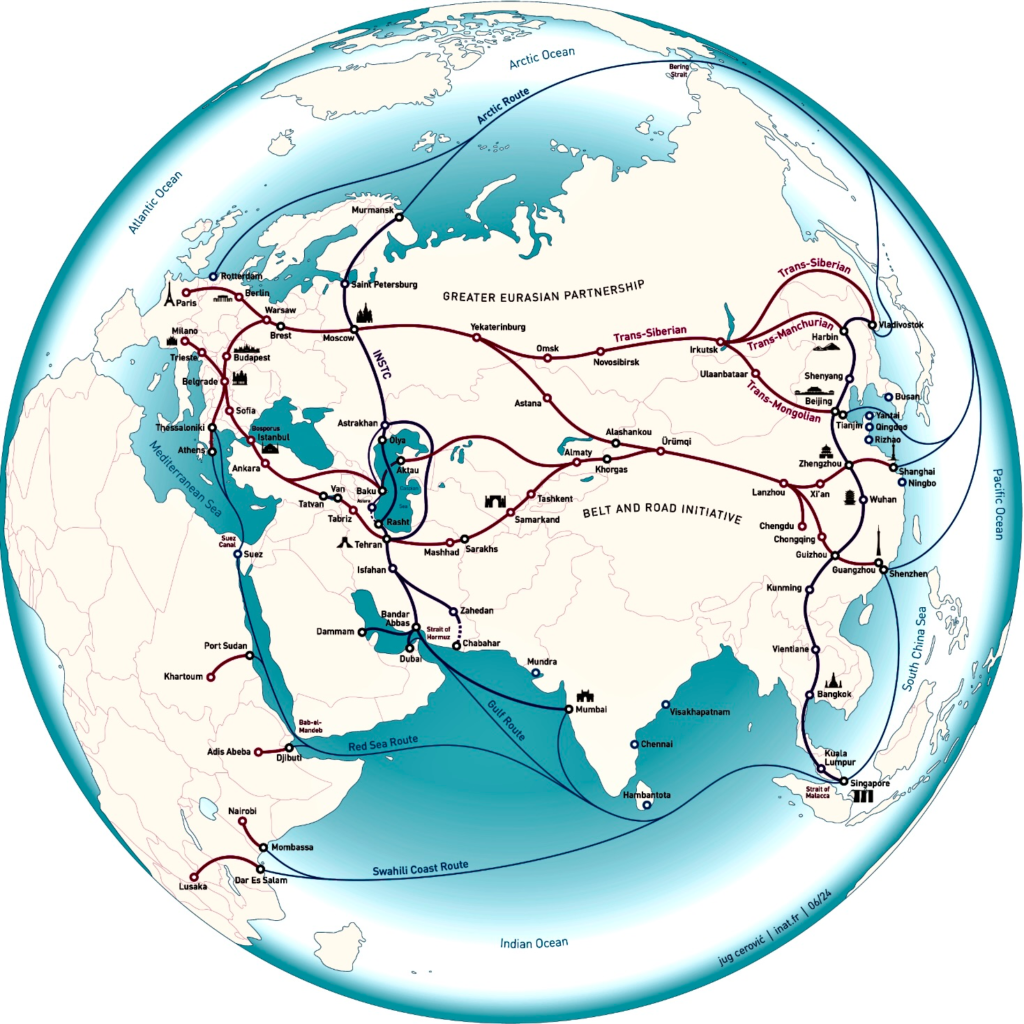
* The “Belt and Road Initiative” (BRI): Investing heavily in overland rail, road, and pipeline networks across Central Asia and Eurasia to bypass maritime shipping lanes entirely.
* Alternative routes: Developing shortcuts like the China-Pakistan Economic Corridor to link the Middle East directly to western China via the port of Gwadar, and building oil/gas pipelines in Myanmar.
* Economic electrification: Investing aggressively in high-speed rail, electric vehicles, and renewable energy to lower its overall reliance on imported crude oil.
* Naval expansion: Developing a “Two Oceans” strategy and a massive “blue water” navy to project military power into the Indian and Pacific Oceans, securing its sea lines of communication.
Over the last two decades, China’s “Malacca Hormuz Axis” strategy has fundamentally transformed its economic infrastructure, geopolitical footprint, and energy security.
* China aggressively constructed overland pipelines and alternative ports via bi-lateral agreements, including: pipelines through Central Asia and the massive Power of Siberia pipelines to secure steady, interception-proof oil and gas directly from Russia. Beijing heavily invested in the deep-sea port at Kyaukphyu and built pipelines to create the Myanmar Corridor, running directly from the Indian Ocean through Myanmar into China, entirely avoiding the Malacca Strait. The China-Pakistan Economic Corridor (CPEC) has been created through development of the Gwadar Port on the Arabian Sea in southern Pakistan, to link energy imports directly to China’s Xinjiang region.
* To secure the broader Malacca Hormuz Axis, China expanded its naval reach, investing in or establishing logistical hubs (the so-called “String of Pearls”) spanning from the Middle East to the South China Sea. Beijing has also continuously engaged in advanced ocean mapping and surveillance in alternative maritime chokepoints (like the Sunda and Lombok straits) to maintain operational readiness in the region.
* Fearing severe economic disruption from a naval blockade, China enacted the “Electro-State Transition”, shifting massive resources into renewable energy, electric vehicles, and domestic resource hoarding to reduce its total reliance on imported fossil fuel. In addition, China accelerated its internal connectivity, constructing an astonishing 54,000 kms of high-speed rail to support its industrial base and create overland trade links to Eurasia.
As a result of these steps underpinning China’s trade and energy transition the impact between 2003 vs. 2026 is phenominal:
* Renewable energy surge: In 2003, renewable energy represented a negligible fraction of China’s total energy consumption. By early 2026, China’s clean electricity capacity reached 52%, exceeding fossil fuel-based generation for the first time. Renewable generation now accounts for ~40% of total electricity.
* Coal reliance shift: In the early 2000s, coal dominated electricity generation by over 70%. By early 2026, wind and solar capacities surpassed coal capacity for the first time.
* Crude oil dependency: In 2003, China imported 3 million barrels of oil per day, a figure that soared to over 16 million barrels daily by 2026. Despite this surge the source and vulnerability is significantly reduced.
* Maritime chokepoint dependence: In the 2000s, approximately 80% of China’s crude imports transited the Strait of Malacca and Strait of Hormuz. With diversification, about 45% of China’s seaborne crude and a third of its LNG flows through the Hormuz-Malacca axis by 2026.
So whilst almost every country in the world is struggling in 2026 with significantly higher oil prices, economic and societal uncertainty, as a result of the USA / Israel war and the subsequent blockage of the Strait of Hormuz – China is not one of them, in fact as the leader in renewable energy infrastructure and EV cars it is the biggest winner!!
When I think about the (almost) unbelievable growth in the size of China over the past 30 years I’ve come to reflect on this as a rightful return to its former position as one of the world’s superpowers. It is also deeply engrained in how China thinks about it as well.
Over the past 500+ years, the global balance of power inverted and then shifted back. China dominated the global economy until the mid-19th century. Then a period dominated by the British Empire and Europe until the United States became the largest country by GPD in the world from around 1900 and then led the world for the next century. Today, China has reclaimed the top spot in total economic output, while the US leads in per-capita wealth, geopolitics, and advanced technology.
A statistical breakdown highlights the defining eras:
Economic output (GDP):
* 1700–1850: China maintained the world’s largest economy, accounting for roughly 30% of global GDP at its 1820 peak. The US was still a long way from industrialization.
* 1870–1990: Driven by rapid industrialization, the US economy surpassed China’s, ultimately accounting for up to 26% of the global economy by 1950. China had declined to 6% by 1980.
* Current Trajectory: When GPD is adjusted for Purchasing Power Parity (PPP), China overtook the US as the world’s largest economy in 2014, though the US remains the leader in nominal GDP.
Population and urbanization:
* Historical (1500–1900): China’s massive population base anchored its global dominance, regularly exceeding 300 million people by the early 1800s.
* 20th/21st Century: The US experienced massive population growth through immigration and expansion, growing from under 4 million (in 1790) to over 330 million today.
* Recent Decades: Both nations experienced intense urbanization. US urbanization hit 50% by 1920. China replicated this in the late 20th century, growing from an urbanization rate of under 20% in 1980 to over 60% as millions relocated to metropolitan hubs, such as Shenzhen.
Technological and geopolitical standing:
* The American Century: Following World War II and the Cold War, the US developed the world’s most extensive geopolitical and technological footprint, maintaining a massive military and a dominant orbital infrastructure (e.g., operating roughly 526 satellites).
* Emerging tech leadership: The balance has shifted across specialized research. Organizations like the Australian Strategic Policy Institute (ASPI) indicate China now leads in 37 of the 44 most crucial sectors for global technology, such as hypersonics, AI, and green energy, critical for the future.
Living standards:
* The prosperity gap: While China’s overall economic mass has grown tremendously, a prosperity gap remains. US GDP per capita is above $85,000, compared to China’s at roughly $13,000.
To read more about the China’s history this is covered in the “Why Beijing feels like being in the Headmaster’s office” post and “The GOAT of Great Walls to keep troublemakers out” post.