From 1 October 1949, Beijing has been the heart of the centralized, one-party political system of the People’s Republic of China (PRC). The Chinese Communist Party (CCP) holds ultimate authority, with government institutions acting as administrative bodies to implement the Party’s policies.
The ultimate philosophical and ideological goal of the CCP is the realization of a communist society, characterized by the abolition of social classes, the elimination of private property, and the development of a system where “from each according to his ability, to each according to his needs” is achieved. To achieve this the Chinese political system is acts under an authoritarian approach. There are no freely elected national leaders, political opposition is suppressed, all organized religious activity is controlled by the CCP, dissent is not permitted, and civil rights are curtailed.
This one-party state therefore operates on the principle of unified state power, in which the legislature, the National People’s Congress (NPC), is constitutionally enshrined as the “highest state organ of power.” With 2,977 members in 2023, it is the largest parliamentary body in the world. By law, all elections at all levels must adhere to the leadership of the CCP. All government bodies and state-owned enterprises have internal CCP committees that lead the decision-making in these institutions.
China’s two special administrative regions (SARs), Hong Kong and Macau, are governed under the “one country, two systems” principle.
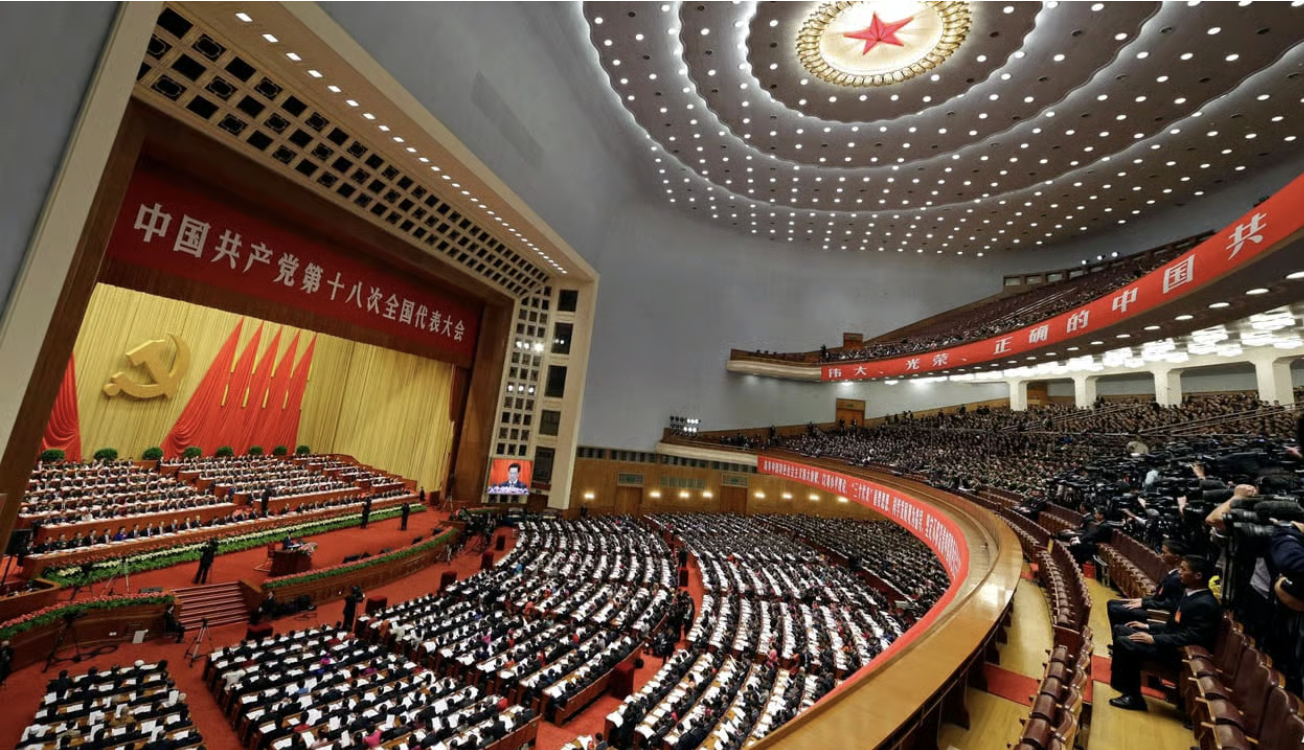
The NPC meets annually, in the Great Hall of the People on the west side of Tiananmen Square (see main photo above), for about two weeks in March to review and approve major new policy directions, and in between those sessions, delegates its powers to the working legislature, the NPC Standing Committee (NPCSC). The NPCSC adopts most national legislation, interprets the constitution and laws, and conducts constitutional reviews, and is headed by the chairman, one of China’s top officials. The head of the State Council, the NPC’s executive body, is the premier. The general secretary of the Chinese Communist Party is China’s leading official, currently Chairman Xi Jinping, since the CCP is tasked with formulating and setting national policy which the state, after being adopted by the NPC or relevant state organ, is responsible for implementing.
Constitutionally, the CCP’s supreme body is its National Congress, which meets every five years. The CCP elects the National Congress who elects the Central Committee which in turn elects:
* the Secretariat, the principal administrative mechanism of the CCP, headed by the General Secretary;
* the Politburo Standing Committee, the most powerful decision-making body in China, which as of June 2020 consists of seven members;
* the Politburo, consisting of 22 full members (including the members of the Politburo Standing Committee);
* the General Secretary, which is the highest-ranking official within the Party and usually the Chinese paramount leader or Chairman;
* the Central Military Commission.
Power is concentrated in the “paramount leader,” an informal title currently occupied by Xi Jinping, who heads the three most important political and state offices: He is the general secretary of the CCP Central Committee, Chairman of the Central Military Commission, and President of the PRC.
China’s Five-Year Plans are developed through a rigorous two-to-three-year, top-down and bottom-up consultative process that balances central leadership directives with grassroots feedback. It ensures policy continuity by combining strategic goals from the Communist Party with the administrative execution of the government. China’s Five-Year Plans (FYPs) are central government blueprints charting the country’s economic and social development.
Since 1953, the PRC has implemented 15 FYPs, shifting from early Soviet-style heavy industrialization to high-tech innovation, green transition, and economic resilience. Through these FYPs China has successfully grown to its current status along side the USA as the most influential country in the world. There has been some mistakes made in the earlier phase, especially under Chairman Mao Zedong, however since the 1990s the country’s growth has been at a break-neck pace.
Below is an overview of the pivotal Five-Year Plans in the PRC’s history.
| Plan | Years | Focus | Key Achievements & Significance |
|---|---|---|---|
| 1st | 1953–1957 | Heavy Industry, Collectivization | Soviet technical assistance, rapid industrialization, and the foundational phase of state-planned economy. |
| 2nd | 1958–1962 | “Great Leap Forward” | Shift toward mass mobilization and communes. Resulted in widespread economic disruption and famine. |
| 6th | 1981–1985 | “Reform and Opening Up” (following the devastating 10 years Cultural Revolution policy, 1966 – 1976) | Introduction of market-oriented reforms, the household responsibility system in farming, and Special Economic Zones. |
| 11th | 2006–2010 | “Scientific Outlook on Development” | Focus shifted to addressing environmental degradation and regional inequality, moving beyond growth-at-all-costs. |
| 12th | 2011–2015 | Strategic Emerging Industries | Transition toward consumer-driven economy, green technologies, and high-value-added manufacturing. |
| 13th | 2016–2020 | Supply-Side Structural Reform | State-backed programs like Made in China 2025 targeting global leadership in AI, robotics, and advanced tech. |
| 14th | 2021–2025 | “Dual Circulation” & High Quality Growth | Focus on domestic market reliance (internal) and international trade (external). Heavy emphasis on carbon neutrality goals and tech self-reliance. |
| 15th | 2026–2030 | Technological Self-Reliance & Modernization | Focus on national security, industrial upgrading, high-quality development, and building technology-driven capabilities amidst global competition. |
Since the CPP came into power in 1949, China’s human rights landscape has been marked by periods of mass mobilization, severe state repression, and strong control over anything that may be used as a medium to facilitate ideas and movements not in the interests of the CCP. This is the downside of a central-authoritarian government. The CCP has been responsible for the devastating politically-driven social campaigns of the Mao era and modern crackdowns of minority groups and idealistic movements. The Tiananmen Square Massacre is one instance, plus over the past ten years the oppression of Uyghurs in the Xinjiang region and heavy crack-downs on pro-democracy protesters in Hong Kong are close to my heart.